Faster Isn't Smarter: Testing Inkling 2 Mini and RL Adapters on My Own Workload
Everyone seems to have a new model that's supposedly better than Sonnet. I tested Inkling 2 Mini and RL adapters against my daily-driver Qwen3.8-27B on an RTX A5000, using real coding tasks, long-context sessions and my own workload. The results were a little different from what Twitter suggested.

It's 2 a.m. again, and somehow the universe is against the idea that I should ever sleep on time. This time, X (Twitter) was telling me that a new 26B model was better than Claude Sonnet.
And naturally, my itch to test it for myself kicked in. Download the model, configure it, set up the benchmarks, and let everything run overnight.
My numbers said something a bit different. Here's what happened.
The Setup
I run local models on a single RTX A5000 (24 GB VRAM) inside a Proxmox VM on my homelab. My current daily driver is Qwen3.8-27B, a 4-bit GGUF running on a plain llama.cpp build. It serves a 196k-token context pool shared across four slots.
My coding agents, Pi and OpenCode, use it for actual work in my repositories throughout the day. My voice assistant also uses it for shorter replies and some internal tool calls.
That's the baseline every claim in this post gets measured against. Not a public leaderboard. Not someone else's Mac Studio. The model I already depend on, running on the hardware I actually have. With 24 GB of VRAM, I can comfortably run one 27B model at a time, so anything new has to earn that GPU slot.
How I Benchmark
Before getting into the results, a quick explanation of how I test things. Every number below comes from one of three benchmark suites. None of them is a public leaderboard benchmark. They're built around the kind of work my machines actually do.
Suite 1: Workload Replay (speed and behaviour)
This suite replays the shape of my actual traffic against the model's API, with streaming enabled, exactly the way my clients call it. The long-context content isn't lorem ipsum. It's taken from a real coding-agent session, so it contains the same mixture of code, tool output and conversation that the model normally sees.
Prompts are sized using a fixed 2.6 characters per token, ensuring every engine and model gets byte-identical input. Each cold request also starts with a random nonce so prompt caching doesn't give anyone an unfair advantage. The tests cover:
| Test | What it checks |
|---|---|
| Fast | Short responses, time to first token and generation speed |
| Effort | Whether none, low, medium and xhigh reasoning levels are accepted, and whether none actually disables thinking |
| Tools | Flat bash calls, read calls and nested edit calls with multiple edits |
| Vision | Whether the image projector loads and processes images |
| Long context | Prompt processing, time to first token, generation speed, cache reuse and hidden-codeword recall at 30k, 90k and 150k tokens |
| Concurrency | Combined throughput and per-request speed with one and four simultaneous requests |
Why these tests? Because a model that generates quickly but breaks tool calls is not particularly useful to a coding agent. And a model that looks great at 2k tokens but takes forever at 150k isn't going to work particularly well with my sessions.
Suite 2: Agent Smoke Tests
This one tests the entire agent loop, not just the model's API. I ran three small tasks through the actual Pi agent. Each run gets a fresh copy of the starting files, and a hidden verifier checks the result afterwards. The tasks were:
- t1: Create
hello.txtcontaining exactlyOK, then stop. - t2: Run failing tests in
test_stats.py, identify and fix the bugs instats.py, and leave the tests untouched. - t3: Add a
remove_item(name, qty)method to an inventory class, handle validation and edge cases, and implement a matching CLI subcommand that persists the changes.
Two runs per task. Nothing particularly exotic, but enough to catch models that struggle with basic instruction following or the agent execution loop.
Suite 3: The 16-Task Coding Suite
This is the one that answers the more interesting question: is the model actually good at coding? Sixteen tasks, split into two groups.
Six replays of real commits. Each task starts from the parent of an actual commit in one of my repositories. The agent gets a prompt describing the change, and the tests introduced by the original commit grade its implementation. These cover things like:
- Adding a pre-commit hook with release-config-driven module scopes.
- Extending my vault viewer to serve ZIP files, including routing, headers, CSP and UI changes.
- Fixing a rollback bug in Hermes Agent.
- Security fixes involving email
Fromheaders and SPF/DKIM authentication results. - Making staged-patch previews accurately reflect what will be applied.
Ten hard synthetic tasks. These are small, realistic repositories with bugs or specifications that require more than just making the visible test pass. They cover:
- Date and timezone handling, including DST.
- A log-filter CLI with several interacting rules.
- Bash backup rotation and retention.
- Optimising O(n²) functions without changing behaviour.
- Layered configuration loading.
- Git archaeology.
- Threaded job queues and race conditions.
- IP-plan validation, including IPv4 and IPv6.
- Function renaming with runtime-loaded plugin references.
- An expression evaluator tested against 4,000 random expressions.
The graders are hidden from the agent. Every task was validated in both directions: the untouched starting code must fail, and a reference implementation must pass.
The rules are identical for every model and harness:
- Fresh copy of the repository for every run.
- One run at a time.
- 20-minute limit per run.
- No other client using the GPU when a run starts.
- No shared memory, personal instruction files or skills.
I wanted to test the models, not how much advantage they could get from my existing configuration.
One honest limitation: it's one run per task. A one- or two-task difference is within noise. This suite tells me whether something is clearly better, clearly worse or roughly equivalent. It isn't a leaderboard.
RL Adapters: Real, Just Not What the Model Card Says
First up, harness-hub released LoRA adapters for Qwen3.8-27B, each trained using reinforcement learning for a particular agent harness: OpenCode, Pi and Hermes. The model cards claimed some pretty significant improvements. The Pi adapter, for example, reported SWE-bench Pro (hard subset) moving from 39.2% to 64.7% with thinking disabled.
Those numbers were measured using full-precision weights on vLLM. I run a 4-bit GGUF on llama.cpp. So naturally, I wanted to see what happened on my setup.
The 16-task coding suite ran every configuration through all sixteen tasks. That's 80 agent runs and roughly thirteen hours of GPU time. Here's what I got:
| Configuration | Passed | Total time | Runs that hit the 20-min cap | Median model calls | Median tokens generated per task |
|---|---|---|---|---|---|
| OpenCode + base Qwen, medium thinking | 13/16 | 278 min | 12 | 16 | 19.8k |
| Pi + base Qwen, medium thinking | 12/16 | 146 min | 1 | 14 | 12.5k |
| OpenCode + OpenCode adapter | 11/16 | 80 min | 0 | 14 | 4.3k |
| Pi + Pi adapter | 10/16 | 102 min | 1 | 12 | 6.3k |
| Pi + base Qwen, thinking off | 9/16 | 160 min | 3 | 30 | 10.6k |
So, did they work?
On accuracy, no. Neither adapter beat the base model running with medium thinking. The differences are small enough that, with one run per task, I wouldn't claim that either configuration is definitively worse. The base model and Pi adapter disagreed on four of the sixteen tasks.
On speed, yes. Against my default setup (Pi with base Qwen at medium thinking, 146 minutes), the Pi adapter finished in 102 minutes, about 1.4x faster, and the OpenCode adapter in 80 minutes, about 1.8x faster.
Comparing the OpenCode adapter to OpenCode's own baseline makes it look like 3.5x (278 down to 80 minutes). I wouldn't quote that one. OpenCode with medium thinking hit the 20-minute cap on 12 of its 16 runs, so its total is mostly timeouts, not work. It still passed 13, though, which says it was usually right and just slow to stop.
On tokens, also yes. The adapters write a lot less. The median task took 12.5k generated tokens on the base model, 6.3k with the Pi adapter (about half) and 4.3k with the OpenCode adapter (about a third).
There's another comparison worth making. The adapters run with thinking disabled, so comparing them only against a model using medium thinking isn't entirely fair. The base Qwen model with thinking disabled managed just 9/16 tasks and took 160 minutes. It also made a median of 30 model calls, more than twice as many as any adapter, and a median of 58 on the real-repository tasks alone. The adapters take shorter, more targeted steps instead.
So the published accuracy gains didn't reproduce on my 4-bit model and my task mix. But the adapters aren't snake oil either.
I kept the OpenCode adapter loaded as a fast mode. Same resident model, switched on per request, without having to reload the weights. Small, well-defined tasks go there. Anything harder stays on the base model.
One gotcha worth mentioning if you're trying this yourself: llama.cpp's --lora-init-without-apply did not keep the adapter switched off in my testing. Every request ran with it applied until I noticed the outputs matched. --lora-scaled FILE:0 is what actually loads it switched off.
Inkling 2 Mini, and "Better Than Sonnet"
Which brings us back to 2 a.m.
Thinking Machines released Inkling 2 Mini, a 26.4B Mixture-of-Experts model with just 3.4B parameters active per token. The interesting part is its architecture. It's a looped transformer: there are 24 layers, but the middle twelve run three times for every token. In effect, it performs 48 layers' worth of computation using 24 layers of weights.
Its published benchmarks put it roughly level with Qwen3.8-27B: tied on the Artificial Analysis Index at 20.1, slightly ahead on some coding benchmarks and behind on others.
Then the posts started. Exo Labs showed it running at 210 tok/s on a Mac Studio and building a weather app "1.8x faster than Claude Sonnet 5.5 and 11x cheaper." Within hours, that had turned into "it's better than Sonnet."
Read that claim again, though. Faster and cheaper is not better. Nobody measured whether the weather app was any good. One app is a demo, not a benchmark.
So I ran it.
Getting It to Load at All
This was a day-one model on a day-one llama.cpp build, and it showed.
Attempt one: Unsloth's GGUF wouldn't load. It complained tensor 'blk.24.attn_q.weight' not found. Its metadata labelled the architecture as inkling2, the non-looped version, so llama.cpp was looking for 48 physical layers that didn't exist. The files from ggml-org, bartowski and LM Studio used inkling2_loop instead, so I switched to ggml-org's IQ4_NL, which was roughly the same 17.6 GB as my Qwen file.
Attempt two: The model loaded. Then it asked for a 38 GB compute buffer on a 24 GB GPU.
Not happening.
It's worth separating the model from the code running it here. The model's attention really does use a learned relative-position bias: how far apart two tokens are changes how much attention they pay each other. That part is the architecture.
How you compute that bias is up to the inference engine. This first llama.cpp implementation builds it as one big float32 table: one value per attention head, per cached token, per token in the current batch. Then it makes a permuted copy of the whole thing. At my settings, that's:
24 heads x 196,608 cached tokens x 1,024 batch tokens x 4 bytes = 18 GiB
plus the permuted copy                                          = 18 GiB
plus everything else llama.cpp needs                            = 38,413 MiB requested
So the memory requirement scales with context length multiplied by batch size. Flash attention doesn't save you here, because the table is built before attention even starts. That's a property of this implementation, merged the day before I tested it, not of Inkling itself.
So I wrote a quick probe to try different configurations one after another.
| Context | Slots | Batch | Result | Prompt speed (10k tokens) |
|---|---|---|---|---|
| 196k, shared pool | 4 | 64 | Fits, 22.3 GB | 368 tok/s |
| 196k, split (49k each) | 4 | 256 | Fits, 22.4 GB | 639 tok/s |
| 196k | 1 | 64 | Fits, 22.1 GB | 490 tok/s |
| 131k | 1 | 128 | Barely fits, 23.4 GB | 550 tok/s |
| 196k | 1 | 128 | Out of memory | – |
| 65k | 1 | 512 | Out of memory | – |
To make the comparison fair, I used the first row: the same 196k context pool shared across four slots that Qwen runs with. The price was a tiny 64-token prompt batch.
The Numbers
Same workload benchmark. Same prompts. Same GPU.
| Measure | Qwen3.8-27B | Qwen + OpenCode adapter | Inkling 2 Mini |
|---|---|---|---|
| Short-context generation | 32–33 tok/s | 28 tok/s | 50–52 tok/s |
| First token, short warm prompt | 0.50–0.90 s | 0.42–0.90 s | 0.17–0.19 s |
| Cold prompt processing at 30k / 90k / 150k | 967 / 793 / 654 tok/s | 840 / 706 / 599 tok/s | 258 / 177 / 129 tok/s |
| First token, 150k cold | 3.9 min | 4.2 min | 21.2 min |
| Follow-up turn at 30k / 90k / 150k | 2.4 / 3.0 / 4.4 s | 2.4 / 3.6 / 4.6 s | 6.2 / 11.2 / 17.6 s |
| Generation at 90k / 150k context | 18.2 / 13.8 tok/s | 16.9 / 13.0 tok/s | 29.4 / 23.3 tok/s |
| Four simultaneous requests, combined | 39.1 tok/s | 34.0 tok/s | 20.6 tok/s |
| Coding suite (one run per task) | 12/16 | 11/16 | 12/16 |
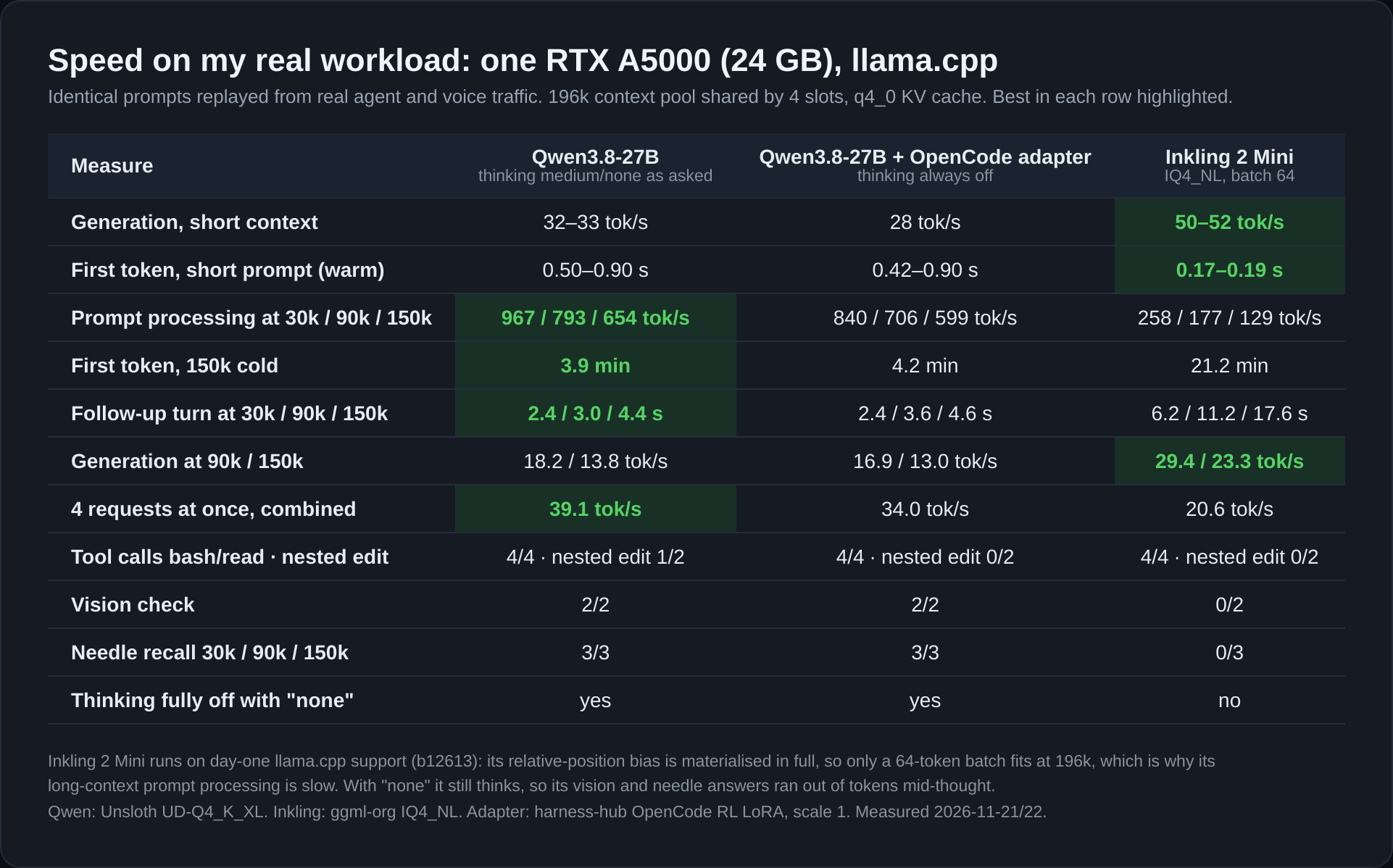
Two very different stories, depending on where you look.
At short context, Inkling is genuinely fast. It generates around 1.6x faster than Qwen and starts answering three to five times sooner. Only 3.4B parameters are active per token, and you can feel it. For something like a voice assistant, that's exactly what you want.
At long context, it falls apart on this engine. Reading a long prompt is four to five times slower. A follow-up turn in a 150k-token session takes 18 seconds instead of four, and a cold 150k prompt takes over 21 minutes before the first token. Four simultaneous requests get roughly half of Qwen's combined throughput. That's the 38 GB table problem again: forced down to a 64-token batch, prompt processing crawls.
A few more things worth knowing:
You can't fully turn its thinking off. With reasoning_effort: none, it still produces reasoning. Short 200-token replies hit the length cap twice out of five runs, and the vision and long-context recall checks also ran out of tokens mid-thought before answering. So those failures don't necessarily mean it can't see or remember. It means it wouldn't stop thinking within the budget I gave it.
Its tokenizer is less efficient on my content. The same text produced roughly 8% more tokens than with Qwen, which eats into the effective context window.
Tool calls mostly work. Flat calls passed every time. The more complicated nested edit call didn't, but Qwen only gets that one right about half the time anyway.
The middle column also shows the cost of the adapter's fast mode. Applying the LoRA weights on every token makes generation 12 to 15% slower and prompt processing 8 to 13% slower. It earns that back by not thinking at all, which is why it finished the coding suite faster than every other configuration I tested.
But Is It Actually Better at Coding?
This is the part I cared about most. On my coding suite, it's a tie.
| Model | Passed | Real commits | Hard synthetic | Total time |
|---|---|---|---|---|
| Qwen3.8-27B (Pi, medium thinking) | 12/16 | 4/6 | 8/10 | 146 min |
| Qwen + Pi adapter (Pi, thinking off) | 10/16 | 4/6 | 6/10 | 102 min |
| Qwen + OpenCode adapter (OpenCode, thinking off) | 11/16 | 5/6 | 6/10 | 80 min |
| Inkling 2 Mini (Pi, medium thinking) | 12/16 | 4/6 | 8/10 | 131 min |
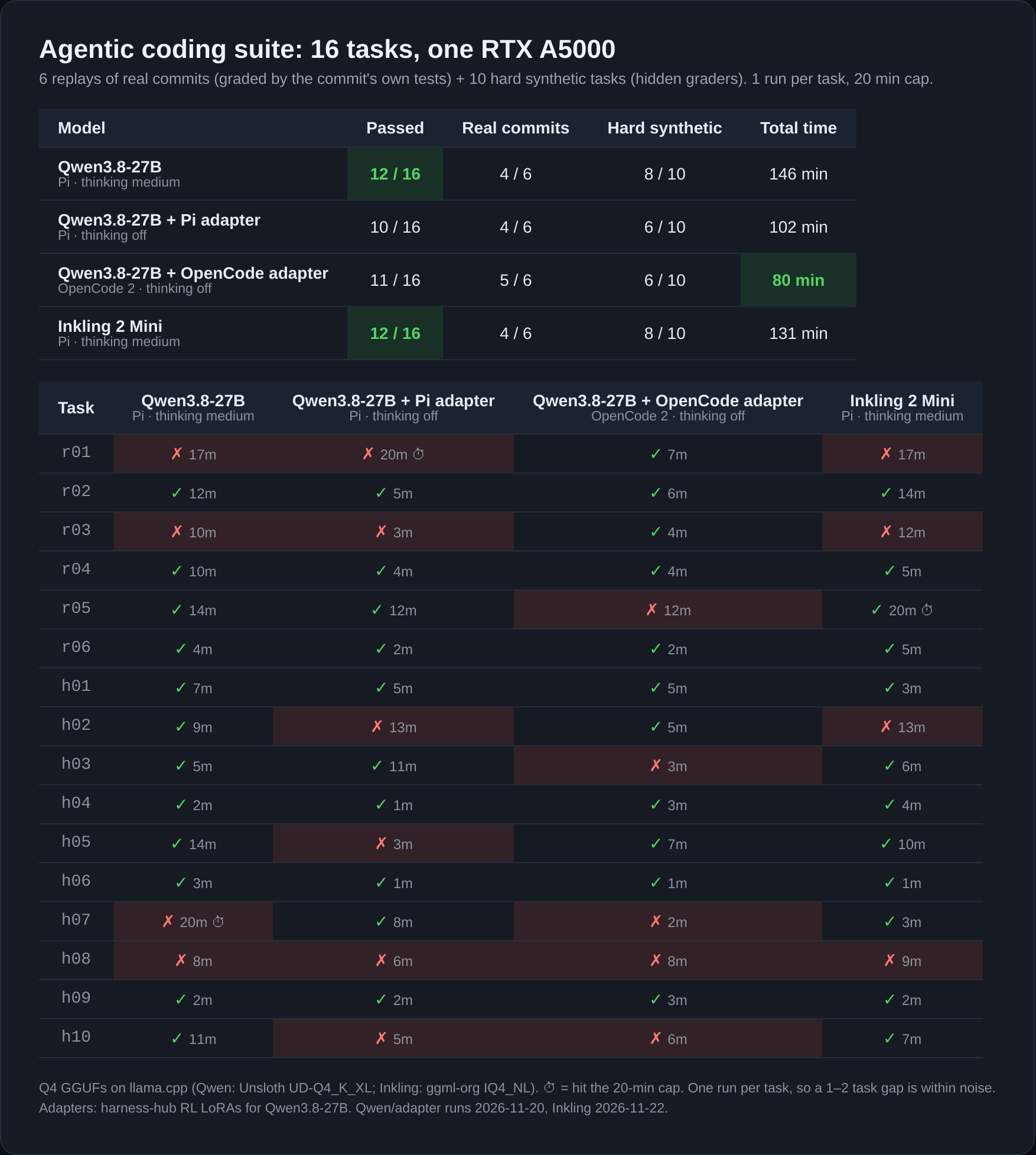
Inkling 2 Mini passed 12 of 16 tasks, exactly the same score as Qwen running with medium thinking: four of six real-commit replays and eight of ten hard synthetic tasks. It finished all sixteen in 131 minutes against Qwen's 146 minutes, approximately 10% faster.
Fourteen of the sixteen tasks went exactly the same way for both models, and the other two cancelled each other out. Inkling failed the log-filter CLI task (h02), which Qwen solved. It then solved the threaded job queue (h07) in three minutes, where Qwen ran out of the 20-minute clock.
It made slightly fewer model calls, with a median of 13 against 14, but generated more tokens per task: a median of 14.7k against 12.5k. So the time it saved came from generating faster, not from doing less work. On these tasks, that outweighed the slow prompt processing.
Of course, sixteen tasks and one run per task aren't enough to declare a winner. Two tasks flipping either way would change the story. But they're enough to say that, on this particular workload, Inkling is competitive with the model I already use every day.
So Is It Better Than Sonnet?
Nothing I ran measures Sonnet, so I won't claim anything about Sonnet either way. What I can say is that on my actual coding tasks, Inkling 2 Mini lands exactly level with a 27B dense model that I already run every day. That's a genuinely impressive result for a model with 3.4B active parameters.
It just isn't the result people are posting.
The 210 tok/s on a Mac Studio is real too. It comes from Exo's hand-tuned MLX implementation. My 50 tok/s and the slow prompt processing come from a llama.cpp implementation that had been merged just the day before I tested it. The same weights can be four times faster or slower depending on how mature the inference engine is. That's worth remembering every time you see a speed number on Twitter.
Where the Time Went
People sometimes ask how long this kind of testing actually takes. Here's the honest answer, straight from the logs.
| What | Time |
|---|---|
| RL adapter testing | |
| Pi + base Qwen, medium thinking | 146 min |
| Pi + Pi adapter | 102 min |
| OpenCode + base Qwen, medium thinking | 278 min |
| OpenCode + OpenCode adapter | 80 min |
| Pi + base Qwen, thinking off | 160 min |
| Total: 80 agent runs | ~12.8 hours |
| Inkling testing | |
| Building llama.cpp from source | 16 min |
| Downloading the unloadable Unsloth GGUF | 25 min |
| Downloading the ggml-org GGUF | 26 min |
| Failed model swaps | ~6 min |
| Probing context and batch configurations | 3 min |
| Qwen workload replay | 10 min |
| Inkling workload replay | 36 min |
| Qwen + OpenCode adapter replay | ~10 min |
| Inkling agent smoke tests | 3 min |
| Inkling coding suite | 131 min |
The pattern is interesting. The benchmark runs themselves are the cheap part because they run unattended overnight. The expensive part is everything around them: downloading the wrong file, hitting unexpected memory requirements, rebuilding llama.cpp, and getting a day-one model to load at all.
What I've Actually Learned
A few things from this entire exercise.
1. Measure on your own workload. The adapters' SWE-bench improvements and the "better than Sonnet" claims were measured on someone else's setup. Neither result was necessarily false. Neither was what I got on my tasks.
2. Faster and smarter are different axes. The adapters were faster without demonstrating an accuracy improvement. Inkling is faster at short context and, on my coding tasks, exactly as capable as the 27B model I already run. Both are useful. Neither is quite what the headlines suggested.
3. The inference engine matters as much as the model. Inkling on day-one llama.cpp versus Exo's MLX implementation is a substantial speed difference on the same weights. A speed number without the engine attached tells you very little.
4. Benchmark at the context you actually use. A model that's incredibly quick at 2k tokens can be practically unusable at 150k. My coding-agent sessions regularly sit between 50k and 150k tokens. That's where a new model has to prove itself.
What's Next
Qwen stays the daily driver. Inkling stays on disk, and I'll rerun the same benchmarks once llama.cpp stops building that 38 GB table. A model this fast at short context deserves another look once the inference engine catches up. The OpenCode adapter stays as my fast mode for smaller jobs.
And I'm keeping the benchmark suite around. Next time a model is supposedly "better than Sonnet", it'll take me one evening to find out what that actually means on my hardware.
TL;DR
I tested two hyped releases against Qwen3.8-27B, the model I run every day on a single RTX A5000, using my own workload and a 16-task coding suite built from real commits.
The RL-trained LoRA adapters finished the coding suite 1.4x to 1.8x faster than my default setup and wrote a third to a half as many tokens, but didn't demonstrate an accuracy improvement on my tasks.
Inkling 2 Mini, the new "better than Sonnet" model, tied Qwen at 12 of 16 coding tasks while finishing approximately 10% sooner. It's also 1.6x faster at short context, but four to five times slower at long context on day-one llama.cpp.
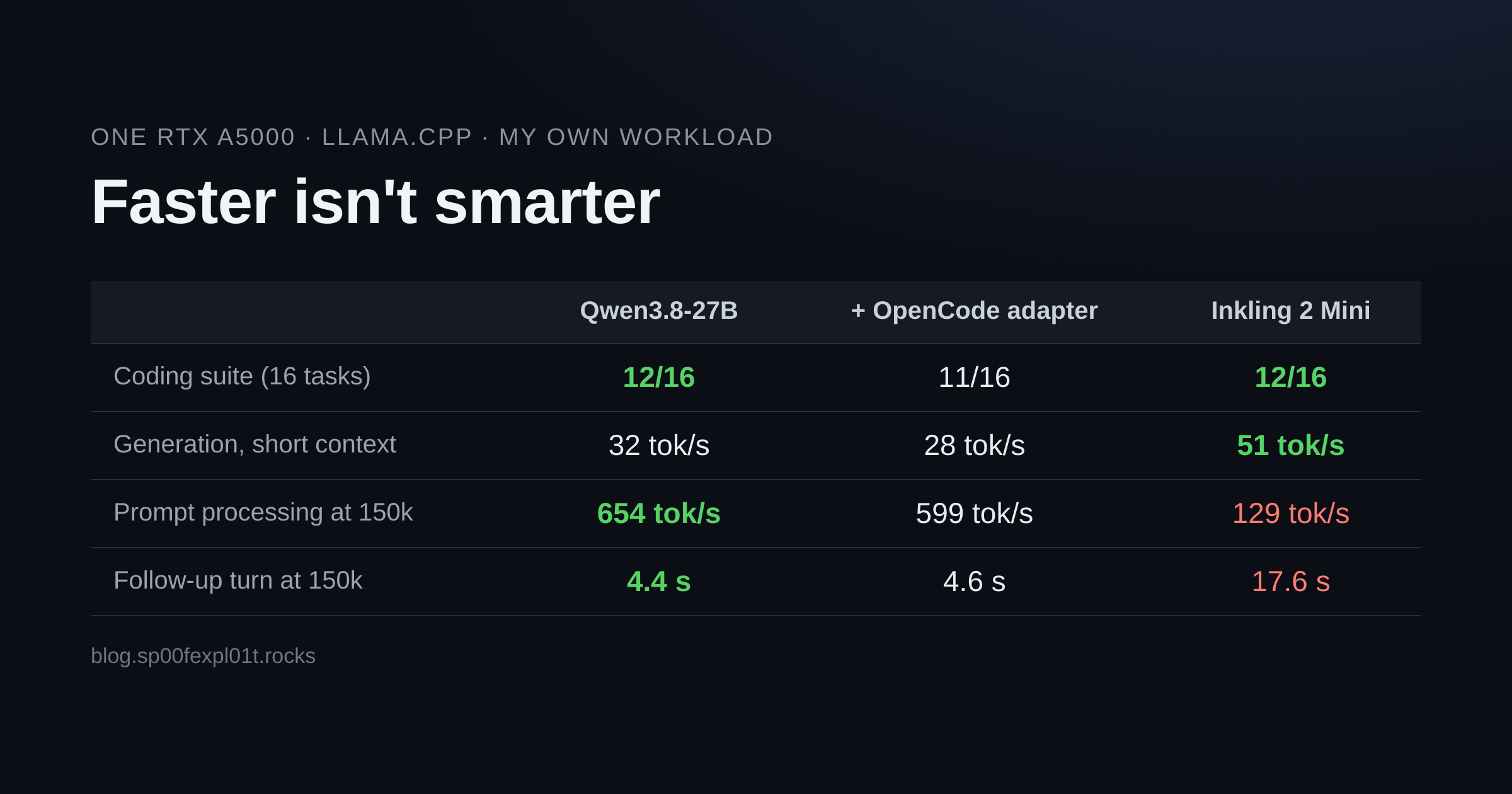
Faster isn't smarter. And the only benchmark that really matters is the one that resembles the work you're actually doing.